When I first started making money through social media, I wasn’t building a personal influencer account.
I wasn’t filming myself talking to the camera every morning.
I wasn’t sharing every part of my day either.
I was building faceless pages.
I’ve grown faceless quote pages on Instagram and Facebook, gotten monetized, and made money from them. That experience taught me something that I think more beginners need to hear:
You don’t have to become the product to build an online business.
And that applies to digital products too.
If you’ve created an ebook, Canva template, printable, planner, guide, or another digital download, you might be wondering how you’re supposed to promote it when you don’t want to constantly show your face.
The good news is there are plenty of ways to market digital products while keeping the brand, not you personally…at the center.
That’s what we’re covering today.
Not every possible marketing strategy on the internet. 😂
Just a simple beginner roadmap for getting your product in front of the right people.
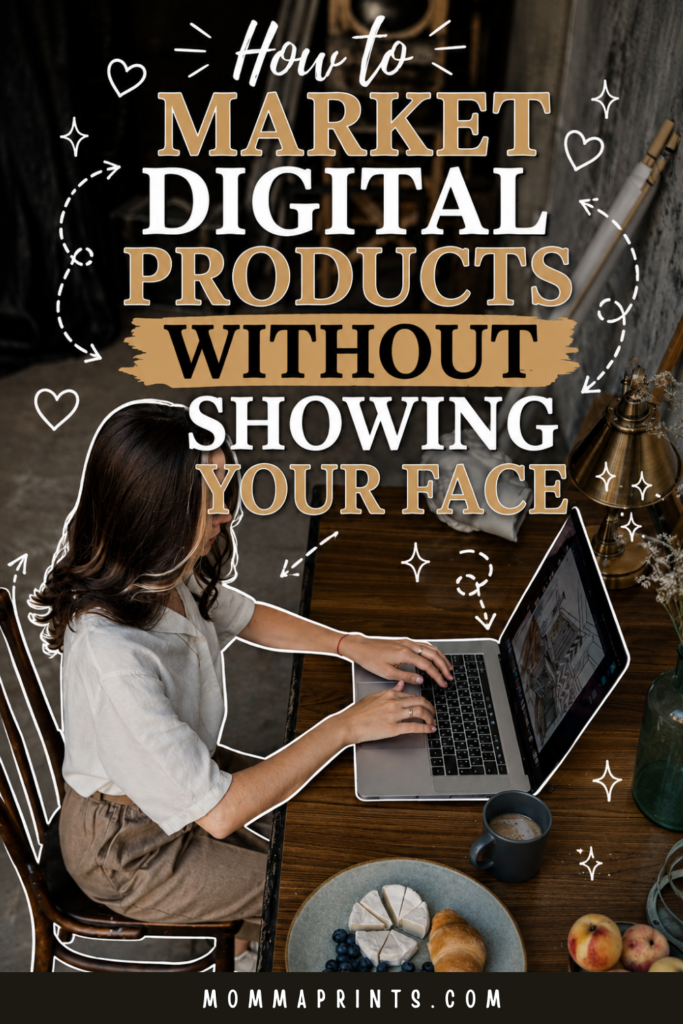
If you have Pinterest, would you mind saving this image for me? 😊
Can You Sell Digital Products Without Showing Your Face?
Yes, because people aren’t necessarily buying a digital product because they know what you look like.
They’re buying because they believe the product can help them.
Think about what matters when you’re considering a purchase online.
Does the product solve your problem?
Is the offer clear?
Does the website look trustworthy?
Can you understand what you’re getting?
Does the creator provide useful information?
Those things can build trust without requiring daily talking-head videos.
The key is making sure your faceless brand still feels human, useful, and trustworthy.
Faceless should never mean anonymous-looking, generic, or disconnected.
Step 1: Get Very Clear About Who Your Product Helps
Before you think about Instagram, Pinterest, Reels, or email marketing, start here.
Who is your product for?
Let’s say you’ve created a content planner.
That’s still broad.
Is it for:
Busy moms building businesses?
New Instagram creators?
Small business owners?
Faceless content creators?
Bloggers?
The more clearly you understand your customer, the easier your marketing becomes.
You’ll know what problems to talk about.
You’ll know which content to create.
Most importantly, you’ll stop trying to market to everybody on the internet.
Step 2: Market the Problem Before the Product
This is one of the biggest mindset changes I would make when learning to market digital products.
Don’t only talk about what you made.
Talk about why someone needs it.
Imagine you sell a 30-day social media content planner.
Instead of posting:
“My content planner is available now!”
you might create content around:
Never know what to post on Instagram?
How to plan one month of content without feeling overwhelmed
5 reasons you’re constantly running out of content ideas
A simple way to batch your social media content
Now you’re talking about the problem.
Your planner can naturally become part of the solution.
That’s a much softer way to market.
Step 3: Create Helpful Faceless Content
Your content can do a lot of your marketing for you.
And no, you don’t have to stand in your kitchen holding a tiny microphone. 😂
Faceless content can include:
- Text-based Reels
- Carousels
- Quote graphics
- B-roll videos
- Screen recordings
- Tutorials
- Pinterest Pins
- Blog posts
- Product mockups
- Educational graphics
The format matters less than the usefulness of the idea.
Your goal is to create content that attracts the same type of person who would benefit from your product.
Step 4: Use Pinterest to Bring People to Your Products
Pinterest can fit especially well with a faceless digital product business.
Your face doesn’t have to be on your Pins.
Instead, create Pins around searchable topics connected to your product.
For example, if you sell Canva templates for content creators, your Pinterest content might cover:
Instagram post templates
Social media content planning
Those Pins can lead directly to a relevant product page when appropriate.
However, they can also lead to helpful blog content that introduces the product naturally.
That brings us to one of my favorite strategies.
Step 5: Use Blog Posts to Market Your Digital Products
Blogging gives you room to help someone before asking them to purchase anything.
Let’s say you sell a digital guide about building a faceless business.
You might write articles such as:
How to Start a Faceless Instagram Account From Scratch
How to Grow a Faceless Instagram Page From 0 Followers
How to Create and Sell Digital Products Online as a Beginner
How to Use Pinterest to Sell Digital Products for Beginners
Each article answers a specific question.
Then, when it’s genuinely relevant, you can introduce your paid resource as the deeper next step.
The path might look like:
Pinterest → Blog Post → Digital Product
That’s exactly the type of content ecosystem I’m building here on MommaPrints.
Step 6: Build Trust Without Becoming the Face of Your Brand
People still need a reason to trust a faceless business.
Your content can provide that reason.
Share useful information.
Be clear about what your products include.
Write in your own voice.
Show product previews.
Answer common questions.
Create helpful tutorials.
Use consistent branding.
You can also share your own experiences without sharing every private detail of your life.
I’ve talked here about my experience growing and monetizing faceless social media pages because it’s directly relevant to what I’m teaching.
That’s different from feeling like I need to document my entire day online.
You get to choose the boundary.
Want the Deeper Faceless Business Strategy?
If you’re reading this because you want to build more than a few random social media posts, that’s exactly why I created:
The Faceless Business Blueprint: Build, Grow & Monetize a Social Media Brand Without Showing Your Face.
My free MommaPrints blog posts are meant to help you understand individual pieces of the process.
Inside the Blueprint, I go deeper into the how behind building your faceless presence, creating purposeful content, growing an audience, exploring monetization, and developing an online business around your brand.
So keep using the free guides while you’re learning.
When you’re ready for the deeper roadmap, the Blueprint is there.

Step 7: Show the Product Without Showing Yourself
If you’re selling something, people should still be able to see what they’re getting.
Create mockups.
Show sample pages.
Record your screen scrolling through the product.
Create a short video showing what’s included.
Zoom in on specific features.
You can even create a carousel explaining how someone might use the product.
For example:
Slide 1: What’s Inside My 30-Day Content Planner?
Slide 2: Monthly planning page
Slide 3: Content idea section
Slide 4: Weekly planning pages
Slide 5: Who it’s designed for
Now the product is the star of the content.
Not your face.
Step 8: Create Content Around the Transformation
People usually care less about the number of pages in your product than what those pages help them accomplish.
Let’s say you’re selling a Pinterest planner.
Instead of only saying:
“Includes 42 printable pages!”
talk about what those pages are designed to help with.
For example:
Stop wondering what to Pin every day and start organizing your Pinterest content ahead of time.
That’s much more meaningful.
When you market digital products, think about the before-and-after experience.
What feels difficult before using the product?
What is the product designed to make easier?
Keep your claims realistic, but communicate the benefit clearly.
Step 9: Create More Than One Marketing Angle
You don’t need to repeat the exact same promotional message every week.
One digital product can generate many content angles.
Imagine you’re selling an ebook about faceless business.
You could create content around:
Beginner mistakes
Common questions
Quick tips
Myths
How-to tutorials
What’s inside the ebook
Who the ebook is for
Problems the ebook helps address
Related blog posts
Lessons from your own experience
You’re still marketing one product.
You’re simply approaching it through different conversations.
That keeps your content from feeling like one long advertisement.
Step 10: Start an Email List
Not everyone who finds your content is ready to buy today.
That’s completely normal.
Give people another way to stay connected.
Offer a free resource that attracts the same audience your paid product serves.
That might be:
A checklist
A Canva template
A printable
A mini guide
A short training
Then use your emails to continue providing helpful information.
Share new blog posts.
Send useful tips.
Introduce relevant products when they fit.
Your email list gives interested readers another opportunity to learn from your brand without relying entirely on social media reach.
Step 11: Create a Simple Content Path
Your marketing doesn’t need to become complicated.
Start with something like:
Helpful Content → Website → Email List or Product
Pinterest might bring someone to a blog article.
An Instagram Reel might lead someone to your profile.
A Google search could bring another reader directly to your website.
Different doors.
Same business.
Once you start thinking this way, your content feels less random because every piece has a purpose.
Step 12: Don’t Try to Be Everywhere
This one is especially important if you’re building your business around family life, work, and everything else on your plate.
You don’t need Pinterest, Instagram, TikTok, Facebook, YouTube, Threads, a podcast, and a carrier pigeon. 😂
Choose a few channels you can realistically maintain.
Then build a repeatable system.
You might focus on:
Pinterest + Blog + Email
Or:
Instagram + Pinterest + Website
Create one useful idea and repurpose it when appropriate.
One blog post can become Pinterest Pins, a carousel, a Reel, and an email.
That’s much more manageable than creating something completely different for every platform.
Step 13: Make Your Product Page Do Its Job
Marketing doesn’t stop when someone clicks.
Your product page should clearly answer:
What is this?
Who is it for?
What does it include?
What problem does it help with?
How will I receive it?
Use readable copy and helpful product images.
If people arrive interested but still can’t figure out what they’re buying, more traffic won’t solve the problem.
Clarity matters.
Step 14: Pay Attention to What Brings Results
Don’t assume your prettiest post is your best marketing content.
Look at what people actually do.
Which Pins bring outbound clicks?
Which blog topics attract readers?
What content gets saves or shares?
Which pages lead people toward your product?
What questions keep coming up?
Use those clues.
If one topic repeatedly attracts the right audience, create more content around it.
Marketing becomes much easier when you’re responding to real behavior instead of constantly guessing.
Step 15: Give Your Strategy Time
Building a faceless business still requires consistency.
A digital product doesn’t become passive simply because you uploaded the file.
You need ways for people to discover it.
That can take time.
Keep publishing useful content.
Create new Pins.
Improve your product pages.
Build your email list.
Learn what your audience responds to.
Then adjust.
You don’t need to have everything figured out before you begin.
Final Thoughts
You absolutely can market digital products without turning yourself into an influencer.
Start with the customer.
Understand their problem.
Create useful faceless content around that problem.
Use Pinterest and blogging to help the right people discover you.
Build trust through helpful information and clear product previews.
Give interested visitors a reason to join your email list.
Then introduce your product naturally when it makes sense.
Your face doesn’t have to be your marketing strategy.
Your ideas, content, brand, and products can do that work.
And for anyone who loves creating but would rather not live in front of a camera, that’s a pretty freeing way to build an online business.
Ready to Build Your Faceless Business?
If you want to go deeper than this beginner roadmap, take a look at:
The Faceless Business Blueprint
Build, Grow & Monetize a Social Media Brand Without Showing Your Face
I created it for beginners who want the deeper how behind building a faceless presence, creating purposeful content, growing an audience, exploring monetization, and developing an online business without making themselves the center of the brand.

My experiences are my own, and results aren’t guaranteed. Sales, income, traffic, social media growth, reach, and monetization vary based on your products, audience, niche, content, marketing, demand, and platform changes.
Keep Reading on MommaPrints
Continue building your digital product strategy with these related guides:
- How to Use Pinterest to Sell Digital Products for Beginners
- How to Get Traffic to Your Digital Products With Pinterest
- 15 Pinterest Pin Ideas to Promote Your Digital Products
- How to Start a Faceless Digital Product Business for Beginners
Get Free Templates, Tips & Training 💌
Subscribe to MommaPrints for free templates, useful tips, and beginner-friendly training, plus exclusive freebies, early product drops, and special discounts on MommaPrints digital products.
Follow MommaPrints on Pinterest 📌
Follow MommaPrints on Pinterest for digital product marketing, Pinterest tips, faceless business ideas, Canva inspiration, online business strategies, and content ideas for building a business without showing your face.