You made the digital product.
You fixed the fonts approximately 17 times.
The product page is live, the checkout works, and now you keep refreshing your sales dashboard like maybe the first order will magically appear if you check one more time. 😂
I’ve been there.
Creating a digital product can feel like the hard part until you actually publish it. Then you realize you have a completely different job:
Getting the right people to find it.
If you’re working toward your first digital product sale, you don’t necessarily need thousands of followers, a viral Reel, or a giant email list.
What you do need is a useful product, a clear reason to buy it, and a simple way to consistently put that product in front of people who may actually need it.
Here’s the beginner roadmap I would focus on.
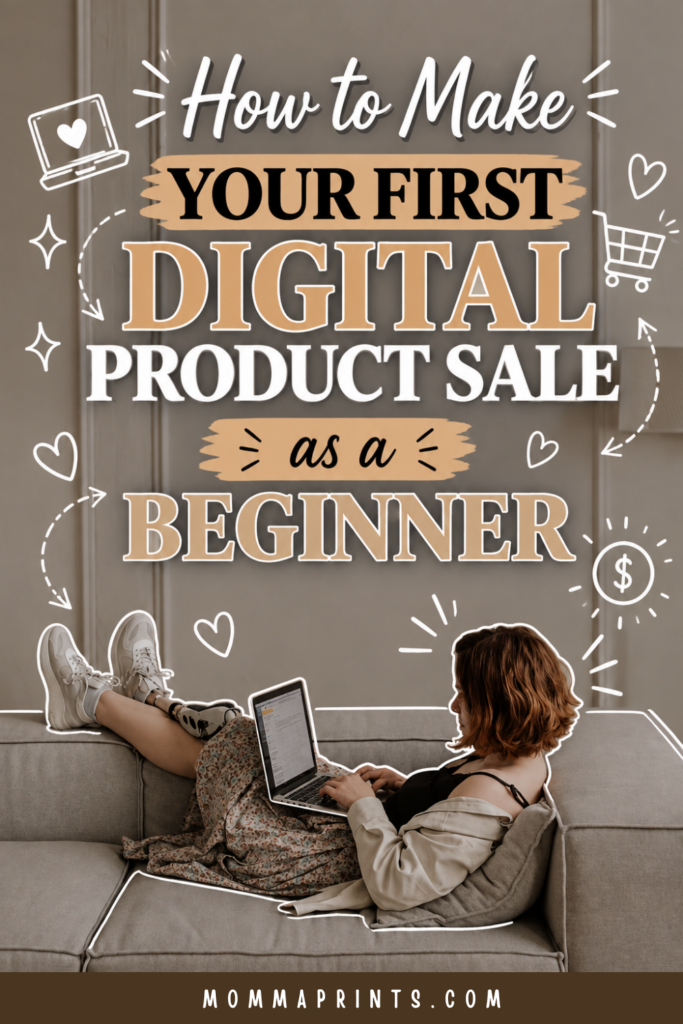
If you have Pinterest, would you mind saving this image for me? 😊
1. Make Sure Your Product Solves a Clear Problem
Before worrying about Instagram, Pinterest, or traffic, look at the actual product.
What does it help someone do?
People aren’t usually buying a PDF because they’re deeply passionate about downloading PDFs.
They’re buying the result.
A busy mom might buy a meal planner because she wants to stop wondering what’s for dinner every night.
A creator might buy Canva templates because she wants to create content faster.
A parent might purchase printable activities because she needs something fun to keep the kids occupied.
Make the Benefit Easy to Understand
You should be able to explain your product in one or two simple sentences.
Instead of:
“A beautiful 35-page printable collection.”
Try:
“A printable activity bundle filled with easy fall and Halloween activities you can have ready for the kids in minutes.”
Features still matter. However, the benefit gives someone a reason to care.
2. Don’t Wait for a Huge Audience

This is probably one of the biggest things beginners overthink.
You might tell yourself:
I’ll start selling when I have 5,000 followers.
Then 5,000 becomes 10,000.
Suddenly, you’ve spent a year trying to become an influencer when your original goal was to build a business.
You do not need a massive audience to make your first digital product sale.
A smaller group of interested people can be enough to get started.
Focus on the Right People
Imagine you sell a beginner Canva template bundle.
Would you rather have 20,000 random followers or 500 people actively trying to create social media content?
I’d take the second audience.
Don’t only ask:
“How do I get more followers?”
A better question is:
“How do I get my product in front of more people who need this?”
That small shift changes the way you market.
3. Create a Product Page That Actually Explains the Product

You finally get someone to click your link.
Don’t make them solve a mystery once they arrive.
Your product page should quickly explain what the product is, who it’s for, what they receive, and how it can help.
Include clear product images or mockups when they make sense.
Answer the Questions a Buyer May Have
Think about anything that could make someone hesitate.
Is this a digital download?
What files are included?
How will I receive it?
Can I print it at home?
Do I need Canva?
Is it beginner-friendly?
Who would find it useful?
You don’t need to write a novel.
Just remove unnecessary confusion.
Your goal is to help someone confidently decide whether the product is right for them.
ALSO READ:
- How to Create and Sell Digital Products Online as a Beginner
- 15 Pinterest Pin Ideas to Promote Your Digital Products
4. Start Talking About the Problem Before the Product

One mistake I see with digital-product promotion is jumping immediately to:
“Buy my new template!”
But someone who just discovered you may not know why they need it.
Start with the problem.
If you’re selling a social media content planner, you could create content about running out of ideas, posting inconsistently, or wasting an hour deciding what to post.
Now your product has context.
Teach First, Then Connect the Product
Create useful content around the same problems your product solves.
You can educate.
Share tips.
Tell a relatable story.
Answer a common question.
Then naturally mention your product when it’s relevant.
That feels much more human than turning every post into an advertisement.
5. Pick One Main Traffic Source First
Trying to be everywhere is exhausting.
Instagram.
Pinterest.
TikTok.
Facebook.
YouTube.
Email.
And apparently you’re also supposed to sleep somewhere in there. 😂
For your first digital product sale, you don’t need to master every platform.
Choose one main place to start bringing people toward your product.
For me, I especially like the potential of Pinterest for digital products because Pins can lead people directly to product pages and helpful blog content.
Instagram can also be useful for building familiarity and creating a community around your niche.
The best starting platform depends on your product and audience.
Pick one. Learn it. Then expand.
6. Create Content That Leads Somewhere
Not every piece of content needs to sell something.
Actually, I wouldn’t recommend that.
However, some of your content should have a next step.
Suppose you create a Pinterest Pin about:
25 Digital Products You Can Create in Canva
That Pin could lead to a useful blog post.
Inside the article, you might naturally introduce a relevant resource or product.
Another Pin could lead directly to your product page when the search intent makes sense.
Your content now has a job.
Think in Simple Paths
Someone might discover:
Pinterest Pin → Blog Post → Product
Another person could find:
Instagram Reel → Profile → Product Page
Someone else might go:
Blog Post → Email List → Product
You don’t need an enormous complicated funnel.
You need clear paths.
Want a Deeper Roadmap for Building the Business Behind Your Content?
Making one digital product is exciting.
Figuring out how your content, audience, brand, and monetization fit together can feel a little less simple.
That’s one reason I created:
The Faceless Business Blueprint: Build, Grow & Monetize a Social Media Brand Without Showing Your Face.
Here on MommaPrints, I share free beginner guides to help you understand individual pieces of building a faceless online business.
Inside the Blueprint, I go deeper into the how behind building your faceless presence, creating purposeful content, growing an audience, exploring monetization, and developing a business around your brand.
If you’re still learning, keep reading the free resources. When you’re ready for a more complete roadmap, the Blueprint is there.
7. Create More Than One Promotional Post
Please don’t make one Instagram post, hear crickets, and decide nobody wants your product.
People miss posts all the time.
Someone might need to see your product more than once before they’re interested enough to click.
Another person may discover the same offer through Pinterest three weeks later.
Promote the Same Product From Different Angles
You don’t need to repeat the exact same sales message.
Change the angle instead.
Show what the product includes.
Talk about the problem it solves.
Share a behind-the-scenes look at why you created it.
Answer a common question.
Create a tutorial related to the topic.
Turn one product into multiple content ideas.
This allows you to promote consistently without sounding like you’re shouting BUY THIS every day.
8. Use Pinterest as a Search and Discovery Tool
Pinterest can be especially useful when your product connects with something people actively search for.
Think:
Printables.
Templates.
Planners.
Checklists.
Kids’ activities.
Gift guides.
Meal planning.
Business resources.
Instead of only creating Pins that say “Shop My Product,” create Pins around the searches that could lead someone toward your offer.
For example, if you sell a printable Halloween activity bundle, you might create content around Halloween activities for kids, fall family activities, Halloween party games, or printable kids’ activities.
Connect Your Content to Search Intent
Use clear Pin titles.
Write natural keyword-rich descriptions.
Create relevant Pinterest boards.
Link each Pin to the most useful destination.
Most importantly, don’t judge Pinterest after posting five Pins.
Build a collection of useful, searchable content around your niche and learn from what starts getting impressions and outbound clicks.
9. Give People a Reason to Trust You

Trust doesn’t require showing your face.
That’s worth repeating.
You can build a trustworthy brand through helpful content, consistent messaging, useful products, professional product pages, and honest communication.
Show people what they’re getting.
Don’t exaggerate results.
Avoid promises you can’t guarantee.
If you’re teaching something, demonstrate that you understand the subject.
Faceless Doesn’t Mean Invisible
Your personality can still come through in your writing.
Your opinions can show up in your content.
The way you teach becomes recognizable.
Your visual style can feel familiar.
People don’t necessarily need your face to connect with your brand.
They need a reason to believe the person behind the brand understands them.
10. Make Buying Easy

Sometimes the problem isn’t traffic.
It’s friction.
Imagine someone finally decides she wants your product.
She clicks your bio and sees seven confusing links.
Then she finds the product, but the description doesn’t explain whether it’s digital or physical.
Next, checkout feels complicated.
She’s gone.
Test the Entire Process Yourself
Go through your customer journey from beginning to end.
Click the Pin.
Visit the page.
Read the description.
Check the product images.
Add the item to the cart.
Look at checkout.
Make sure the next step is obvious.
You worked hard to bring someone there. Don’t lose them because the buying process is unnecessarily confusing.
ALSO READ:
- How to Sell Digital Products on Instagram Without Showing Your Face
- How to Sell Digital Products Without a Large Audience
11. Pay Attention to Clicks, Not Just Likes

If your goal is your first digital product sale, likes aren’t the most important number.
A post can get lots of likes without generating a single website visit.
Instead, start paying attention to actions closer to your goal.
Are people clicking?
Which Pins send traffic?
Which blog posts attract visitors?
What topics lead people to your product?
Where are people discovering you?
Those clues can help you decide what to create next.
12. Don’t Immediately Assume Your Product Is the Problem
You launched three days ago.
No sales.
Time to delete everything?
Probably not. 😂
There are several reasons you may not have made your first digital product sale yet.
Maybe not enough people have seen the product.
Perhaps your messaging isn’t clear.
Your product page might need improvement.
The audience you’re reaching could be wrong.
Your offer may need work.
Price can also play a role.
Before rebuilding the entire product, try to understand where the problem actually is.
If hardly anyone is visiting the page, changing the cover from pink to beige probably isn’t going to fix your traffic problem.
13. Treat Your First Sale as Information, Not the Finish Line

That first order feels different.
Someone you don’t know decided:
Yes. This is useful enough that I’m willing to pay for it.
That’s exciting.
But your first digital product sale is also information.
What product did they buy?
Where did they come from?
Which content brought them in?
What problem were they trying to solve?
Use what you learn to improve your next product, product page, Pin, Reel, email, or blog post.
That’s how a digital-product business begins to become a system instead of a collection of random things you’re trying online.
Final Thoughts
You don’t need thousands of followers to make your first digital product sale.
You also don’t need 47 products sitting in your shop.
Start with something useful.
Make the benefit clear.
Create a product page that answers obvious questions.
Then focus on getting the right people to see it.
Create content around the problem your product solves. Choose a main traffic source, promote from different angles, and make the buying process easy.
Most importantly, don’t confuse a quiet launch with failure.
Sometimes your product doesn’t need another week of tweaking.
It needs more of the right people landing on it.
Ready to Build the Business Behind Your Digital Product?
If you want to go beyond creating a product and learn more about building the faceless brand around it, take a look at:
The Faceless Business Blueprint
Build, Grow & Monetize a Social Media Brand Without Showing Your Face
It’s designed for beginners who want the deeper how behind building a faceless presence, creating purposeful content, growing an audience, exploring monetization, and developing an online business without needing to become the face of the brand.
Use the free MommaPrints guides as your starting point. If you’re ready to connect those pieces into a bigger strategy, the Blueprint can help you take the next step.
My experiences are my own, and results aren’t guaranteed. Sales, income, traffic, audience growth, and monetization vary based on your product, pricing, niche, audience, marketing, demand, expenses, platform changes, and other factors.
Keep Reading on MommaPrints
If you’re working toward your first sales, these guides are good ones to read next:
- 15 Digital Products You Can Sell Online as a Beginner
- How to Create and Sell Digital Products Online as a Beginner
- How to Price Your First Digital Product as a Beginner
- How to Sell Digital Products Without a Large Audience
- How to Use Pinterest to Sell Digital Products for Beginners
Get Free Templates, Tips & Training 💌
Subscribe to MommaPrints for free templates, useful tips, and beginner-friendly training, plus exclusive freebies, early product drops, and special discounts on MommaPrints digital products.
Follow MommaPrints on Pinterest 📌
Follow MommaPrints on Pinterest for digital product ideas, Pinterest marketing tips, faceless business strategies, Canva ideas, online business tips, and beginner-friendly ways to build income from home.