There’s something I wish more people would tell beginners about selling digital products:
You don’t need 50,000 followers before you’re allowed to sell something.
When you’re scrolling through Instagram, it’s easy to think otherwise.
You see creators with huge audiences launching ebooks, courses, templates, and printables. Then you look at your own account and think:
Well… maybe I’ll make a product when I have more followers.
I understand that feeling.
But I’ve learned through building faceless pages on Instagram and Facebook that a large follower count and a profitable audience aren’t necessarily the same thing.
I’ve grown faceless quote pages, gotten monetized, and made money from social media without making myself the face of those accounts.
That experience completely changed how I look at audience size.
I’d rather have a smaller group of the right people than thousands of followers who couldn’t care less about what I’m offering.
So, can you sell digital products without an audience of thousands?
Yes, you can start small.
However, you still need people to discover your product. That’s what we’re going to talk about today.
No overnight-income promises.
No “post this Reel and make $10K by Friday.”
Just a realistic beginner roadmap.
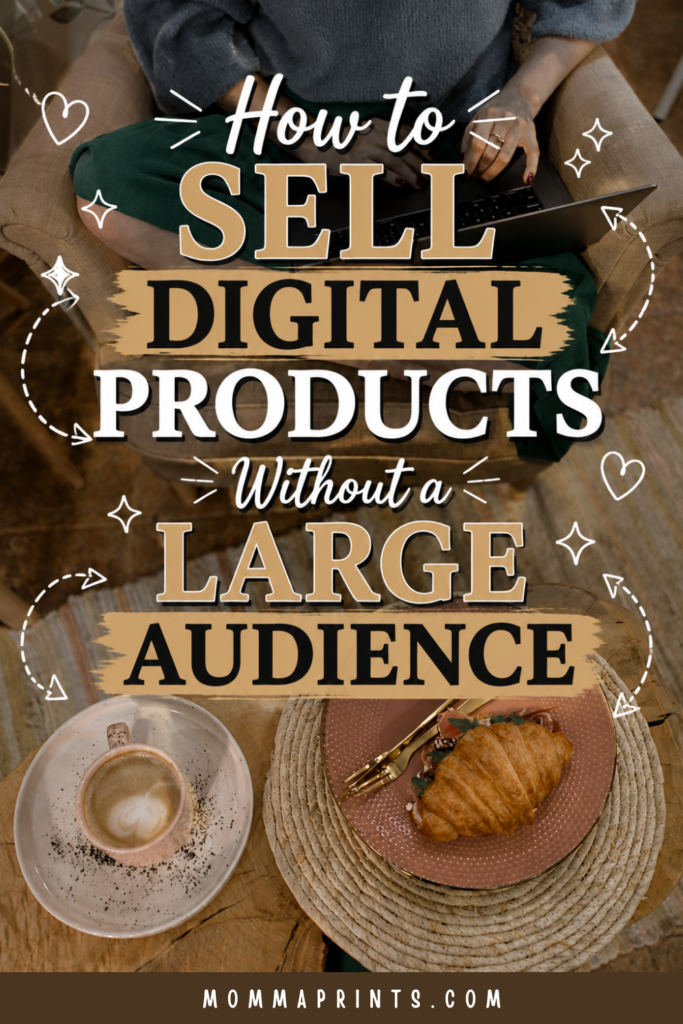
If you have Pinterest, would you mind saving this image for me? 😊
You Don’t Need a Huge Audience, But You Do Need the Right People
Let’s clear up something important.
Selling without a large audience doesn’t mean selling without anyone ever seeing your product.
People still need to discover you.
The difference is that you don’t necessarily need thousands of social media followers before you begin.
Instead of obsessing over follower count, think about targeted attention.
If 200 people find your content and they’re genuinely interested in the problem your product solves, that can be more useful than 20,000 random followers.
So your goal isn’t:
Get as many followers as humanly possible.
It’s:
Help the right people find my business.
That’s a much more manageable place to start.
Step 1: Create Something for a Specific Person
Before worrying about marketing, make sure your product has a clear audience.
“Printable planner” is broad.
“A weekly content planner for busy small business owners” is clearer.
“Canva templates” could mean almost anything.
“Instagram carousel templates for faceless creators” tells you exactly who they’re designed for.
When you’re trying to sell digital products without an audience, specificity can help because your marketing becomes much easier.
You know what problems to discuss.
You know what keywords to target.
Most importantly, you know who you’re trying to reach.
Step 2: Solve One Clear Problem
Your first product doesn’t need to solve every problem your customer has.
Pick one.
Maybe your customer struggles with:
Coming up with content ideas.
Planning meals.
Organizing household routines.
Creating social media graphics.
Budgeting.
Starting a faceless business.
Your product should make something easier, faster, clearer, or more organized.
Ask yourself:
What will someone be able to do with this product that they’re struggling to do now?
That’s the benefit you’ll eventually market.
Step 3: Stop Waiting for a Follower Milestone
This is where beginners can lose months.
“I’ll launch at 1,000 followers.”
Then 1,000 becomes 5,000.
Meanwhile, the product stays buried inside a Canva folder.
You can start building the product side of your business while you’re growing your audience.
In fact, having a clear offer can give your content more direction.
Instead of posting random tips hoping something takes off, you can create content around the same problems your product addresses.
Now your content and product support each other.
Step 4: Create Helpful Content Around Your Product
Let’s say you created a digital content planner.
Don’t spend every day posting pictures of the planner.
Create content about:
How to plan a month of social media content
What to post when you’re out of ideas
Simple ways to organize your social media calendar
You’re attracting people interested in the problem.
Some of those people may eventually want the product.
That’s how you can begin to sell digital products without an audience that’s already huge.
Your content helps build the audience around the offer.
Step 5: Use Search-Based Content to Get Discovered
Social media followers aren’t the only way people can find you.
This is especially important.
Pinterest and search-friendly blog content can give you other discovery paths.
Imagine you write:
25 Digital Product Ideas You Can Create in Canva
Then you create several Pinterest Pins around that article.
Someone searches Pinterest for Canva digital product ideas.
They discover your Pin.
They visit your website.
While reading, they discover another relevant article or one of your products.
That person didn’t need to follow you first.
They found you because they were already searching for the topic.
That’s why I’m building Pinterest and blogging into the MommaPrints strategy instead of depending on one social media platform alone.
Step 6: Build a Small Content Ecosystem
One helpful article is great.
Several connected articles are even better.
Let’s say your business is about digital products.
Your content might include:
How to create your first digital product
How to market digital products
How to use Pinterest to sell digital products
Now someone can discover your website through one topic and continue reading others.
Each article creates another entry point.
Over time, you’re building a little library around the exact problems your ideal customer wants help solving.
Want the Deeper Faceless Business Roadmap?
This is where everything starts connecting.
You’re not simply creating a product.
You’re building the brand, content, audience, and monetization strategy around it.
That’s why I created:
The Faceless Business Blueprint: Build, Grow & Monetize a Social Media Brand Without Showing Your Face.
The free guides here on MommaPrints give you useful starting points and beginner roadmaps.
Inside the Blueprint, I go deeper into the how behind building your faceless presence, creating purposeful content, growing an audience, exploring monetization, and developing a business around your brand.
You can keep learning through the free articles while you’re getting started.
When you’re ready to connect more of the pieces, the Blueprint is there.

Step 7: Let Pinterest Become Part of Your Traffic Strategy
Pinterest can be especially useful for a small or new brand because your entire strategy doesn’t have to revolve around an existing follower count.
Create Pins around useful topics related to your product.
For example, if you sell a content-planning template, you could create Pins around:
30 Days of Instagram Content Ideas
How to Batch Social Media Content
Faceless Content Ideas for Beginners
How to Create a Monthly Content Plan
Some Pins can lead to helpful blog posts.
Others may lead to a relevant product page when the Pin clearly represents that product.
The goal is creating more ways for interested people to find you.
Step 8: Give People a Reason to Join Your Email List
A visitor might like your content but not be ready to purchase.
Don’t assume that means you’ve lost them.
Offer a relevant free resource.
Maybe it’s:
A checklist
A Canva template
A mini planner
A short guide
A free training
Someone discovers you through Pinterest or a blog post, grabs the free resource, and joins your email list.
Now you have another way to continue the relationship.
You can share helpful tips, new articles, and relevant offers without depending entirely on whether Instagram decides to show your next post.
Step 9: Build Trust Without Showing Your Face
A small audience needs a reason to trust you.
Fortunately, trust isn’t created only by selfies and talking-head videos.
You can build trust through:
Clear information.
Useful content.
Consistent branding.
Helpful tutorials.
Product previews.
Good writing.
Honest expectations.
Your own relevant experiences.
Show people what’s inside the product.
Explain who it’s for.
Tell them what it helps with.
Answer the questions they’d naturally have before buying.
A faceless business should still feel like there’s a real person behind it.
Step 10: Show Your Product in Action
Don’t just announce that your product exists.
Demonstrate it.
If it’s a Canva template, show the template being customized.
Selling a printable planner? Show several pages.
For an ebook, preview the table of contents or selected sections.
If it’s a content calendar, demonstrate how someone might use it to organize a week.
This helps people understand what they’re buying.
You don’t need your face in the video.
The product can be the visual.
Step 11: Talk About the Benefit, Not Just the Features
Beginners often describe products like this:
42 pages!
10 templates!
5 worksheets!
Those details can matter, but they don’t explain why someone should care.
Connect features with benefits.
Instead of:
Includes a 30-day content calendar.
Try:
Plan your next month of content in one place so you’re not starting from zero every morning.
Now I understand why the calendar might help me.
When you have a small audience, clarity becomes especially important.
Step 12: Don’t Be Afraid to Promote Your Product
There’s a difference between constant selling and never selling.
Sometimes we’re so worried about sounding salesy that we barely mention the product.
Then we wonder why nobody buys it. 😂
Create useful content most of the time.
But when your product genuinely fits the conversation, tell people it exists.
Explain who it’s for.
Show what’s inside.
Link to it.
Give people an opportunity to decide.
That’s not being pushy.
That’s running a business.
Step 13: Learn From Your First Visitors
Your early stage can actually be incredibly useful.
Pay attention to what people respond to.
Which Pins get outbound clicks?
What blog posts attract readers?
Which emails get engagement?
What questions do people ask?
Which product pages are getting visits?
Use those signals to improve your content and offer.
You don’t need thousands of people to start learning.
Your first visitors can tell you a lot.
Step 14: Focus on Quality of Traffic, Not Vanity Numbers
It’s easy to become obsessed with:
Followers.
Likes.
Views.
Impressions.
Those numbers aren’t meaningless, but they’re not the whole business.
If your goal is selling digital products, also pay attention to:
Website visitors.
Outbound clicks.
Email subscribers.
Product-page visits.
Conversions.
Customers.
I’d rather have a Pin bring 50 highly interested visitors to a relevant article than thousands of meaningless impressions from the wrong audience.
Step 15: Keep Building While You’re Small
Being small gives you room to experiment.
Try different Pin headlines.
Test content topics.
Improve your product.
Adjust your messaging.
Learn which problems resonate with your audience.
You don’t need everything perfectly optimized before you begin.
Your business can grow alongside your audience.
And that’s probably a lot more realistic than waiting until you’re internet-famous before creating anything to sell.
Final Thoughts
You can sell digital products without an audience of tens of thousands of followers.
What you can’t do is expect people to buy something they never discover.
So focus less on chasing a giant follower count and more on creating ways for the right people to find you.
Create a specific product.
Solve a clear problem.
Publish helpful content.
Use Pinterest and blogging for discovery.
Build an email list.
Show your product.
Explain the benefit.
Build trust.
Then keep improving.
You don’t need to be famous.
You don’t need to become an influencer.
And you certainly don’t need to wait until some imaginary follower number gives you permission to start.
Start building the business while you’re building the audience.
Ready to Build Your Faceless Business?
If you want the deeper how behind turning your content and audience into a more intentional business, take a look at:
The Faceless Business Blueprint
Build, Grow & Monetize a Social Media Brand Without Showing Your Face
I created it for beginners who want to build a faceless presence, create purposeful content, grow an audience, explore monetization, and develop an online business without making themselves the center of the brand.

My experiences are my own, and results aren’t guaranteed. Sales, income, traffic, reach, audience growth, and monetization vary based on your products, content, niche, marketing, demand, platform changes, and other factors.
Keep Reading on MommaPrints
Continue building your digital-product business with these related guides:
- How to Market Digital Products Without Showing Your Face
- How to Use Pinterest to Sell Digital Products for Beginners
- How to Get Traffic to Your Digital Products With Pinterest
- How to Start a Faceless Digital Product Business for Beginners
Get Free Templates, Tips & Training 💌
Subscribe to MommaPrints for free templates, useful tips, and beginner-friendly training, plus exclusive freebies, early product drops, and special discounts on MommaPrints digital products.
Follow MommaPrints on Pinterest 📌
Follow MommaPrints on Pinterest for digital product ideas, Pinterest marketing tips, faceless business strategies, Canva inspiration, online business ideas, and beginner-friendly ways to build an audience without showing your face.