If you’ve ever searched for ways to make money online, you’ve probably come across the phrase passive income approximately 847 times. 😂
And it sounds amazing.
Create something once.
Put it online.
Make sales while you’re folding laundry, picking the kids up from school, or sleeping.
But here’s the part I think deserves more attention:
Digital products can create a more scalable income stream, but they aren’t completely passive.
You still have to create the product. People need a way to discover it. You may need to answer customer questions, update your products, create content, and continue marketing.
Still, I understand why digital products are so appealing.
As a stay-at-home mom who has built faceless pages on Instagram and Facebook, gotten monetized, and made money online without showing my face, I love business models that don’t require me to become an influencer or constantly be on camera.
Digital products can fit beautifully into that kind of business.
So, if you’ve been searching for digital products for passive income, here are 10 beginner-friendly ideas to consider.
This isn’t a promise that every idea will make money.
Think of it as your starting point for figuring out what you could create, who you could help, and which product fits your skills.
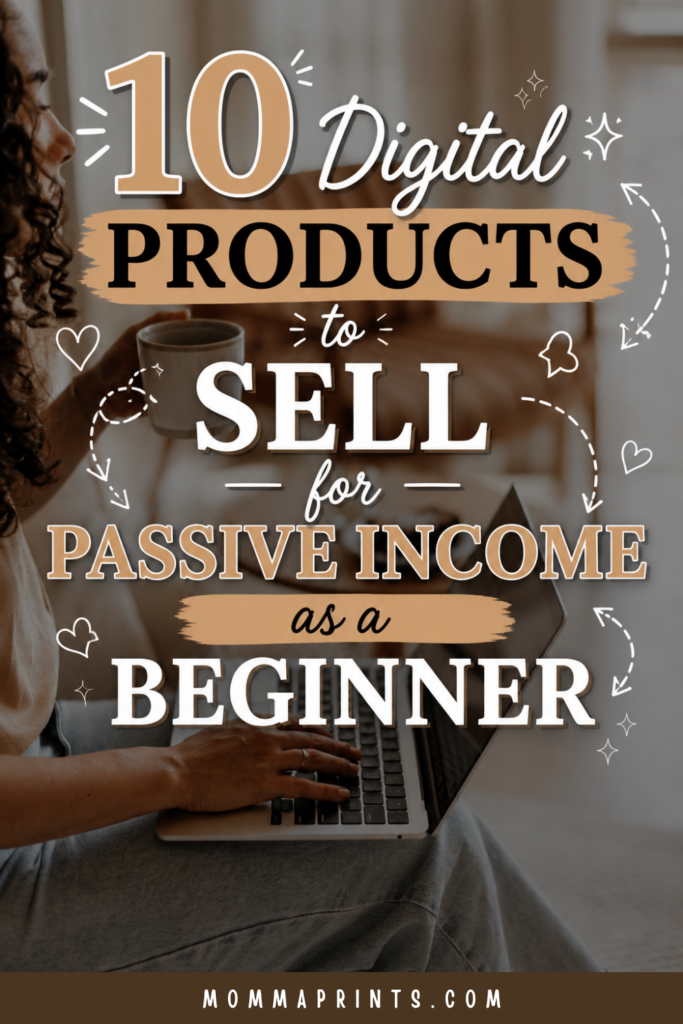
If you have Pinterest, would you mind saving this image for me? 😊
What Are Digital Products?
Digital products are items customers can access electronically rather than receive as a physical shipment.
Depending on the product, that might include:
- Printables
- Ebooks
- Templates
- Planners
- Workbooks
- Checklists
- Digital guides
- Spreadsheets
- Content resources
- Educational materials
Because there’s no physical inventory to pack for each individual order, digital products can be sold repeatedly.
That’s what makes them interesting for anyone looking to build a more scalable online business.
However, your results depend on much more than simply uploading a PDF.
You still need a useful product, an interested audience, traffic, and marketing.
With that out of the way, let’s talk ideas.
1. Printable Planners
Printable planners are one of the first digital products for passive income many beginners think about.
And there are so many directions you could take them.
Instead of creating another generic planner, think about a specific customer or problem.
You might create:
Meal planners
Budget planners
Cleaning planners
Content planners
Homeschool planners
Small business planners
Goal-setting planners
A focused planner usually gives you a clearer marketing angle.
For example, Weekly Content Planner for Busy Creators tells me much more than Cute Printable Planner.
Beginner Tip
Start small.
You don’t need a 150-page planner for your first product. Create something useful that solves one specific organization problem.
2. Canva Templates
If you already enjoy designing in Canva, templates may be worth exploring.
Businesses and creators often need visual content but don’t necessarily want to design everything from scratch.
Ideas could include:
Instagram post templates
Pinterest Pin templates
Instagram Story templates
Media kits
Lead magnet templates
Workbooks
Business graphics
Choose a specific audience.
For example, Pinterest templates for food bloggers are much more targeted than simply “social media templates.”
Before selling any template, make sure you understand the current commercial-use and licensing rules for the platform and individual design elements you’re using.
3. Ebooks and Digital Guides
You don’t need to write a 300-page book to create something valuable.
A focused ebook can teach someone how to solve one particular problem.
Think:
Beginner’s Guide to Meal Planning
How to Start a Vegetable Garden
30-Day Home Organization Guide
Beginner’s Guide to Faceless Content
The best topic usually comes from something you genuinely understand and that your audience wants help with.
That’s actually the thinking behind my own The Faceless Business Blueprint.
I took a topic I had real experience with, building and monetizing faceless social media pages and turned that knowledge into a deeper resource for beginners.
Your own experience may contain product ideas too.
4. Checklists
Don’t underestimate simple products.
Sometimes people don’t need 75 pages of information.
They need to know:
What do I do next?
That’s where checklists can be useful.
You could create:
Digital Product Launch Checklist
Moving Checklist
Wedding Planning Checklist
New Blogger Checklist
Vacation Packing Checklist
Small Business Setup Checklist
A checklist can work as a low-cost product, part of a larger bundle, or even as a free resource that introduces people to your paid products.
The value isn’t in how many pages it contains.
It’s in how much confusion it removes.
5. Digital Workbooks
A workbook goes beyond giving someone information.
It helps them actually do something with it.
For example, a business workbook might include:
Goal-setting pages.
Brainstorming prompts.
Planning exercises.
Worksheets.
Action steps.
Progress trackers.
This can work well when your audience needs guidance through a process.
If you’re considering digital products for passive income, ask whether your topic would be more useful as something interactive rather than something customers only read.
A workbook can give them space to apply what they’re learning.
Want to Turn Your Ideas Into a Faceless Business?
Creating a digital product is one piece of the puzzle.
The next question is usually:
How do I build the brand and audience around it?
That’s why I created:
The Faceless Business Blueprint: Build, Grow & Monetize a Social Media Brand Without Showing Your Face.
The free guides here on MommaPrints are designed to give you beginner-friendly starting points.
Inside the Blueprint, I go deeper into the how behind building a faceless presence, creating purposeful content, growing an audience, exploring monetization, and developing a business around your brand.
You don’t need to figure everything out today.
Keep learning through the free resources. Then, when you’re ready for the deeper roadmap, the Blueprint is there.

6. Social Media Content Calendars
If you’ve ever sat down to post on Instagram and suddenly forgotten every thought you’ve had in your entire life, you understand this problem. 😂
Content calendars can help creators and businesses organize what they’ll publish.
You could create a calendar for:
Small businesses
Real estate agents
Mom bloggers
Faceless Instagram accounts
Food creators
Beauty businesses
Etsy sellers
The more specific the audience, the easier it becomes to make the product genuinely useful.
Instead of filling a calendar with generic prompts like “Share something inspiring,” create ideas that make sense for the customer’s niche.
7. Spreadsheet Templates
Not every digital product needs to be pretty.
Some of the most useful products are simply functional.
Spreadsheet templates could help customers manage:
Budgets
Business expenses
Content planning
Inventory
Savings goals
Project tracking
Business income
If you’re comfortable building spreadsheets, this can be a practical product category.
Keep the user experience simple.
Someone buying a template usually wants it to make their life easier, not require a two-hour tutorial before they can understand what cell B17 does.
8. Printable Kids’ Activities
If your audience includes parents, teachers, or caregivers, printable activities are another option.
Ideas might include:
Coloring pages
Scavenger hunts
Learning worksheets
Road-trip activities
Birthday activities
Seasonal products can be especially fun because you can create collections around holidays, school breaks, and family traditions.
For example, I created my own Fall Family Fun + Halloween Activity Bundle for Kids, which includes 35+ printable fall activities, Halloween games, and creative pages for kids. It’s a good example of taking one seasonal theme and turning it into a larger digital bundle instead of selling every printable separately.
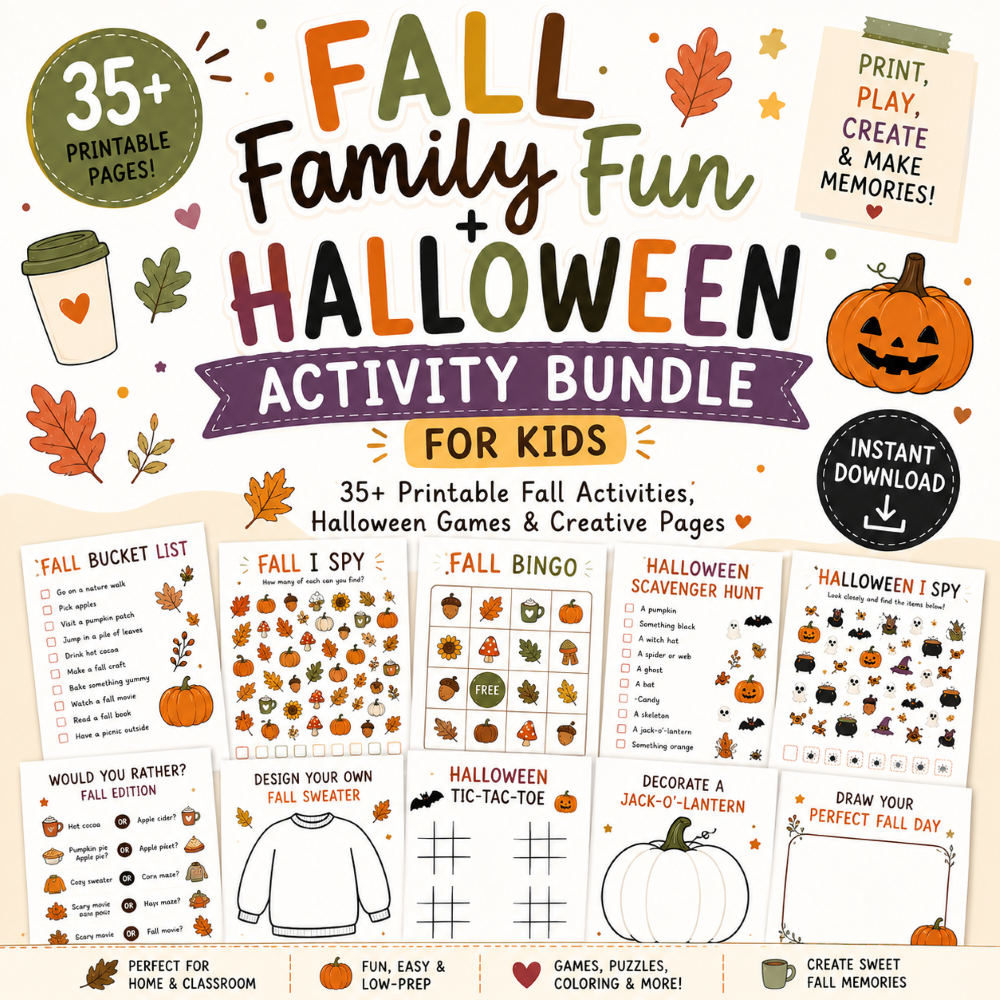
If you decide to create seasonal printables, remember that demand may rise and fall throughout the year. That’s completely normal. Consider mixing seasonal products with evergreen printables so your shop has useful options beyond one particular holiday or season.
Beginner Tip
Think in terms of bundles and occasions, not just individual worksheets. A parent may be more interested in a complete Halloween activity pack, road-trip activity bundle, or rainy-day printable pack than one standalone coloring page.
9. Resource Guides
A resource guide organizes useful information in one convenient place.
For example:
Beginner Blogging Resource Guide
Canva Tools for Content Creators
Home Organization Resource Guide
Small Business Content Guide
Travel Planning Guide
The value comes from organization and usefulness.
Don’t simply copy information someone could easily find elsewhere.
Add your own structure, explanations, experience, recommendations, or process so the resource genuinely saves your customer time.
10. Digital Product Bundles
Once you have several related products, you can eventually combine them into a bundle.
For example, someone selling social media resources might bundle:
Content planner
Hook ideas
Canva templates
Caption prompts
Content calendar
Now the customer gets several related tools together.
However, I wouldn’t start here if you’re brand new.
Create one useful product first.
Learn what your audience responds to.
Then expand.
A bundle makes much more sense when its individual pieces naturally belong together.
Which Digital Product Should You Start With?
If you’re looking at these digital products for passive income and thinking:
Okay… but which one should I actually make?
Start with three questions.
What Do You Already Know?
Think about your skills, experiences, hobbies, work, or routines.
You don’t need to be the world’s leading expert.
However, you should understand the problem you’re helping someone solve.
What Does Your Audience Need?
Look at questions people ask.
Search your niche.
Pay attention to recurring frustrations.
If you’re already creating content, notice what topics get the most interest.
Those clues can help you find potential product ideas.
What Can You Realistically Finish?
Your first product doesn’t need to become your masterpiece.
Choose something you can actually complete.
A useful 15-page guide that gets published is more valuable to your business than a 200-page ebook that’s been sitting unfinished on your laptop since February.
How Do People Find Your Digital Products?
This is the part beginners sometimes skip.
Making the product isn’t enough.
You need traffic.
Your discovery strategy might include:
Blogging
SEO
Email marketing
Faceless content
For example, imagine you sell a printable content planner.
You could publish a blog post called:
How to Batch a Month of Social Media Content in One Day
Then create Pinterest Pins that lead to the article.
Inside the article, your planner becomes a natural next step.
That’s much softer than turning every Pin into an advertisement.
Can You Sell Digital Products Without a Big Following?
Yes, you can start before you have a huge audience.
Instead of waiting for thousands of followers, focus on helping the right people discover you.
Pinterest and searchable blog content can be useful because someone doesn’t necessarily need to follow you first.
They might discover a helpful Pin while searching for an idea.
That Pin leads to your website.
Your blog introduces your brand.
Eventually, they discover your product.
You’re creating multiple paths into your business.
Are Digital Products Really Passive Income?
I prefer calling them scalable rather than completely passive.
You can create a digital file once and potentially sell copies without manually producing another physical item each time.
That’s the attractive part.
But most digital products still need marketing, traffic, customer support, updates, and ongoing business management.
So if you’re researching digital products for passive income, go into it with realistic expectations.
You’re building an asset that can continue selling.
You’re not installing an ATM in your laptop. 😂
Start With One Product, Not Ten
Yes, this article gives you ten ideas.
No, that doesn’t mean you should open Canva tonight and create all ten.
Pick one.
Choose an audience.
Solve one problem.
Create the product.
Publish it.
Start marketing.
Then learn.
Your first product will teach you things that another month of planning never could.
Once you understand what your customers want, you can create the next product more intentionally.
Final Thoughts
There are plenty of digital products for passive income that beginners can explore.
Printables.
Templates.
Ebooks.
Checklists.
Workbooks.
Content calendars.
Spreadsheets.
Kids’ activities.
Resource guides.
Bundles.
But don’t choose a product simply because someone on social media says it’s “trending.”
Start with your customer.
Start by thinking about what your audience actually needs.
Consider how you can help solve a problem for them.
Then choose something useful that you can realistically create.
Then build from there.
A successful digital product business isn’t about having the biggest shop.
It’s about creating something useful and finding the right people who need it.
Ready to Build Your Faceless Business?
If you’re interested in digital products because you want to build an online business without becoming an influencer, take a look at:
The Faceless Business Blueprint
Build, Grow & Monetize a Social Media Brand Without Showing Your Face
I created it for beginners who want the deeper how behind building a faceless presence, creating purposeful content, growing an audience, exploring monetization, and developing an online business around their brand.

My experiences are my own, and results aren’t guaranteed. Digital product sales, income, traffic, audience growth, and monetization vary based on your niche, products, content, marketing, demand, pricing, and other factors.
Keep Reading on MommaPrints
Continue exploring digital products with these related guides:
- 15 Digital Products You Can Sell Online as a Beginner
- 25 Digital Product Ideas You Can Create in Canva
- How to Create and Sell Digital Products Online as a Beginner
- How to Sell Digital Products Without a Large Audience
- How to Market Digital Products Without Showing Your Face
Get Free Templates, Tips & Training 💌
Subscribe to MommaPrints for free templates, useful tips, and beginner-friendly training, plus exclusive freebies, early product drops, and special discounts on MommaPrints digital products.
Follow MommaPrints on Pinterest 📌
Follow MommaPrints on Pinterest for digital product ideas, faceless business tips, Pinterest marketing, Canva inspiration, online business ideas, side hustles, and beginner-friendly ways to build income online without showing your face.